



Using tie screws for formwork
Today, there are two main ways to fasten formwork in monolithic construction: a set of a tightening screw and formwork nuts , or the use of a Chiroz reinforcing spring clamp complete with a key.
Let's consider the first option.
The tension screw for formwork systems (called a "stud" by builders) is a low-alloy steel metal rod manufactured by precision casting. It is threaded throughout its entire length and can be galvanized for corrosion protection. It is this type of tension screw, 3 meters long, that is presented in our catalog.
Since the clamping screw itself is not capable of holding the walls of the formwork, it is used in conjunction with clamping nuts and washers. If it is necessary to reuse the tension screws, to protect them from contact with the solution, use a special PVC tube and cone clamps, which remain in the monolith during demoulding.

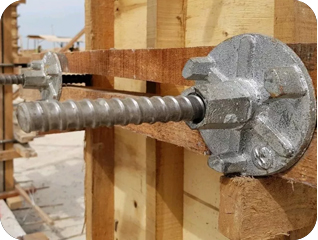 The installation process is quite simple:
- Before installation, through holes are made in the decks for a PVC pipe with a diameter of 22 mm
- a clamping screw is inserted inside the tube, which passes through the parallel panels
- washers are put on the clamping screw on both sides and nuts are attached
- tighten the nuts along the threads until the required distance between the walls of the panels is obtained
It is recommended to install tie screws for formwork with a distance of 10 cm from the edges of the boards. To reliably connect two standard parallel slabs, a minimum of 4 sets of ties are required, but if you calculate their area, the consumption per 1 m² is very small. They should be installed in half-meter increments in two rows, and the bottom of the decks is usually propped up with struts.
This option of fastening the formwork with a tightening screw and nuts is more expensive than using spring clamps, but it also has important advantages. This kit makes it possible to adjust the width of the concrete form with millimeter precision and allows the construction of wall formwork with thicker walls and withstand high loads.

