

Galvanized Formwork Nut
The formwork coupling nut is an important fastening element in monolithic construction. It is used in combination with a coupling screw in formwork systems, which are often used in our country. This also includes "cone" clamps and perforated PVC pipe. Thus, we get a system that fixes two formwork panels together, preventing them from moving apart when pouring the concrete mixture.
In the resulting screed, the role of the support is performed by the clamping nut, therefore, special attention should be paid to its qualitative and technical characteristics. After all, when filling any structure, we need to be sure of the strength of our formwork. Let's consider the main qualitative and strength characteristics of coupling nuts.
 The first is the outer diameter of the nut, the larger it is, the less pressure is transferred to the edge of the formwork shield. When using small diameter nuts, it is recommended to use special washers for the coupling screw, it is designed to protect the coupling screw from rupture and increase the area of support on the edge of the formwork shield.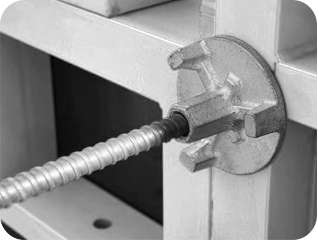
The second is the diameter of the thread, it must match the diameter of the coupling screw.
The third is the material from which the nut is made. At the moment, the choice consists of cast iron and plastic nuts. Plastic nuts are suitable for small loads up to 4 tons, cast iron nuts are always used in industrial construction. They can withstand loads of up to 17 tons.
The fourth is the galvanized coating. Galvanized products will last longer, as they are not subject to corrosion and environmental influences.
Currently, there are many manufacturers and variants of coupling nuts on our market. We offer a reinforced galvanized nut with a diameter of 100 mm made of wrought iron with an internal thread diameter of 15 mm, and a weight of 650 grams. It can withstand loads of up to 20 tons.