



How to install a sewer drain
Sewer ladders are designed to drain water from the floor surface into the sewer network. They are widely used in residential, industrial, public premises: showers and bathrooms, baths and laundries, terraces and balconies, garages and car washes, boiler rooms, basements, etc. They are also used outside — in storm sewers to remove precipitation from roads, courtyards, etc.
Sewer ladders are made of cast iron, plastic, stainless steel, etc. They consist of: a housing (a receiving funnel), a siphon (a water seal) that prevents the penetration of an unpleasant odor from the sewer into the room. From above, the ladders are covered with grilles that prevent debris from entering the sewer. Grilles, depending on the place of installation of the ladder, come in different shapes (decorative, round, square, etc.), size and are made of plastic, cast iron, stainless steel. The ladders are also equipped with sealing and clamping elements designed to seal the structure during installation.
The outlet of the sewer ladder is the place of its connection to the discharge pipe. It can be vertical (directed downwards) to connect to a pipe passing under the floor; or horizontal (directed to the side) to connect to a pipe laid in the floor.
The diameters of the outlet (outlet) of sewer ladders are 50 mm and 100 (110) mm. The choice of diameter depends on the volume of drains passing through them. Shower ladders with a tap diameter of 50 mm are installed mainly in bathrooms of housing construction, and ladders with a tap diameter of 100 (110) mm are used for sports, industrial and other structures. It is also necessary to take into account the purpose of the ladder — for constant drainage of water or drainage of water accidentally falling on the floor.
 When choosing the appropriate parameters of the sewer ladder, it is necessary to take into account the location and operating conditions, the volume of waste water, the possible load, etc.
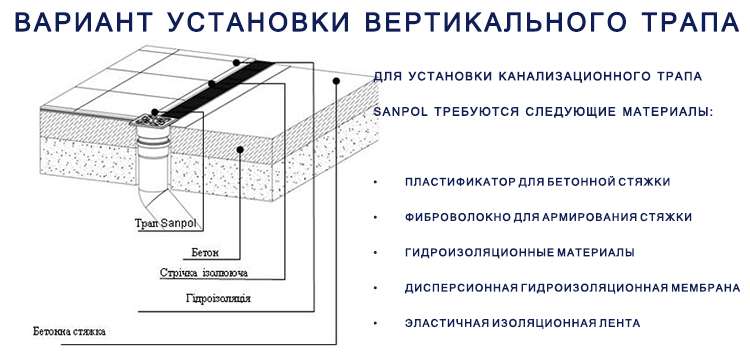
Installation of a sewer ladder begins with the choice of its location — in the center of the room, along the edge or in several places.
A trench is made in the designated place. The whole structure is assembled and placed in a prepared trench so that the top of the grate is 5-10 mm below the floor covering level. Then the ladder is connected to the sewer pipeline, using a waterproofing membrane on the flange of the housing.
The entire structure is fixed in the trench with cement mortar or epoxy compound. After solidification, the floor surface is mounted with its mandatory waterproofing.
For better drainage of drains, a certain slope towards the ladder is necessary. Tile floors are laid with a slopeInstalling a sewer ladder is not a complicated process, but it is responsible. Therefore, in order to avoid unpleasant moments and various emergency situations, it is better to entrust the choice of material and installation to professionals. The specialists of our online store will help you in this matter.

