



The correct way to waterproof a strip foundation made of FBS blocks
External and internal waterproofing of strip foundations made of FBS blocks
Waterproofing of block foundations is much more complex and costly than waterproofing of similar monolithic structures. This is primarily due to the presence of vulnerabilities in the construction of foundations made of FBS, such as interblock joints, which need additional processing and waterproofing. In this article, we will take a step-by-step look at the technology of waterproofing works of such foundations.
So, let's get started..
 Cleaning the surface before waterproofing
The main purpose of this stage is to completely clean the concrete surface from dirt, dust, oils, old waterproofing, protrusions, fragile particles, etc. Everyone has different sources, but the result should be the same - an absolutely clean and smooth concrete base.
Recommended cleaning methods:
- dismantling with a jackhammer (for large protrusions and particles)
- grinding the concrete surface with a diamond bowl
- surface treatment with high water pressure (from 250 atm), we recommend using a "hydrophreeze" nozzle in order to increase the force of the jet.
Cutting of interblock seams and junctions
This stage is performed in parallel with the previous one, since the cutting of seams is accompanied by a large amount of dirt and dust. So, in order not to do the cleaning in an endless circle, we strongly recommend combining these two processes together.
 Before proceeding with the cutting, we recommend that you determine the height of the waterproofing coating from the floor level. As a rule, this is done according to a time-tested formula:
The ground level is 40 cm.
To begin with, it is necessary, with the help of a jackhammer, to knock out the cement composition from all the interblock joints, in the area under waterproofing, to a depth of 30-40 mm. This is a mandatory measure for exterior and exterior waterproofing works.
If wall-to-floor, wall-to-wall, wall-to-ceiling junctions fall into the area of the planned waterproofing, it is necessary to make a 30 mm wide and 30 mm deep groove for internal and external work.
Sealing of interblock seams and junctions
Previously prepared seams and seams at the junctions, at this stage it is necessary to seal up with a high-strength non-shrink repair mixture with high adhesion Teknorep 300 or Teknorep 300 EX. In the presence of active water leaks, they must be eliminated using the composition Teknoplug Yildirim or Teknoplug. The time of complete curing of the formulations is from 1 to 2 minutes, respectively. Along the abutments, we also make a small cutting using the same material. This will significantly reduce the pressure on the waterproofing coating at the joint.
All irregularities and potholes must also be plastered with Teknorep 300 repair mix.
Waterproofing of interblock joints and junctions
It is at this stage that a certain duality appears. The water pressure outside the structure will be positive, and inside it will be negative. This means that starting from this moment, the external and internal waterproofing works will be performed with different materials and different execution technologies.
Outside: Teknomer 200 EX two-component elastic waterproofing material must be applied to all seams and joints. In the area of these zones, small movements are possible during operation, which is why it is necessary to apply a hydrophobic material that will not only be able to block microcracks, but also provide compensation for movements.
Before applying the mixture, the waterproofing area must be moistened. Then, the Teknomer 200 EX solution prepared according to the instructions should be applied in 2 layers using a roller, brush, or maklovitsa. Wait 5-6 hours between applying the layers, depending on the ambient temperature. The layers should be applied perpendicular to each other. The total thickness of the application is 2-3 mm.
Inside: A crystallized two-component hydrophobic material Teknomer 200 Crystallized or Teknomer 200 EX Crystallized, which is designed for negative water pressure, should be applied to the interblock seams and joints.
Waterproofing of communications
At this stage, it is necessary to seal all the inlets, pipes and other passageways. We strongly recommend doing this with a bentonite cord 5x20 mm, based on bentonite clay. To do this, it is enough to make several turns of bentonite cord on the pipe segment, placing it in such a way that it is approximately in the middle of the structure. After that, it is necessary to seal the remaining space using the Teknorep 300 or Teknorep 300 EX repair compound. To do this, the entire surface around the input of communications must be moistened and, using a spatula, very tightly and carefully fill the gap with one of the above solutions.
Waterproofing of the walls of the FBS foundation
From the outside, the entire remaining surface of the concrete blocks is covered with Teknomer 200 EX (which we used for waterproofing the interblock joints) or Teknomer 200. The use of a particular material depends on the strength of the expected water pressure on the structure. We apply the mixture in two layers perpendicular to each other. After the solution has completely dried, glue styrofoam plates onto it.
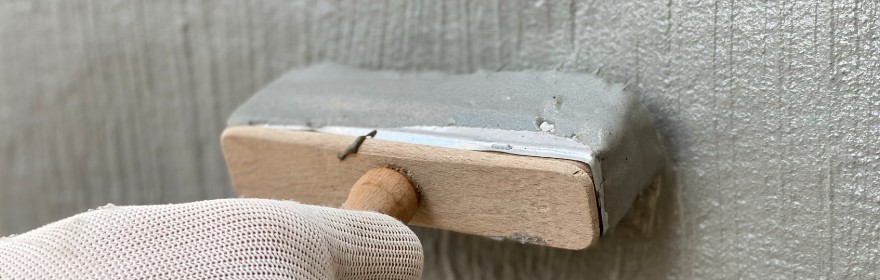
Inside: for internal waterproofing, we use a crystallized two-component hydrophobic mixture Teknomer 200 Crystallized or Teknomer 200 EX Crystallized, which is designed for negative water pressure.
Protection of the waterproofing coating
The internal waterproofing made with Teknomer 200 Crystallized or Teknomer 200 EX Crystallized solutions will be ready for further processing in 3-7 days. But styrofoam plates can be protected with a spiked membrane almost immediately after gluing. To do this, we recommend using a Sintar spiked membrane, with or without geotextile (depending on the required degree of protection).

