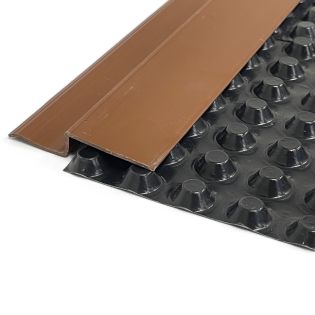


Installation of the tenon membrane
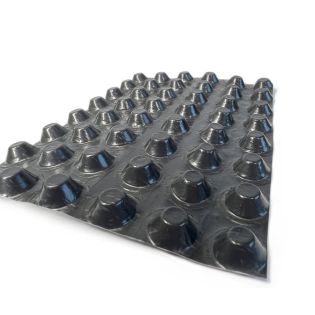
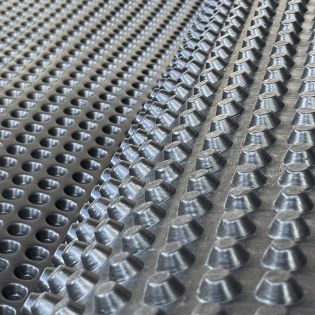
A spike-shaped membrane is a modern material in construction that performs the functions of removing moisture and water from buildings, protecting waterproofing from mechanical damage, and is involved in the construction of blind areas, concrete footings, concrete roads and exploited roofs.
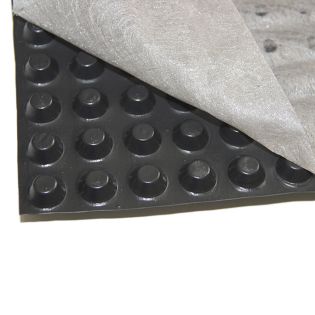
Depending on the purpose, there are types of spike-shaped membranes: with and without geotextiles. They also select the type of density depending on the technical requirements.
One of the advantages of using a tenon membrane is its ease of application. It does not require special equipment, expensive components or special skills. Installation is easy, convenient, and most importantly – fast.
 The tenon membrane can be laid vertically, horizontally, or by combining both options.
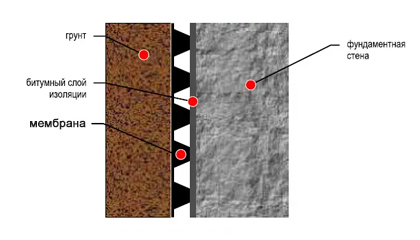 Installation of a tenon membrane vertically (foundations, basements, retaining walls, underground structures, etc.):
- The surface on which the spike-shaped membrane will be attached must be smooth and clean.
- The membrane sheet should be deployed along the wall so that the membrane is 10-30 cm above the level of backfilling soil.
- Using a tenon membrane to protect the waterproofing layer, select a membrane without geotextile and attach it with tenons to the wall.
- When arranging wall drainage, choose a membrane with geotextiles and lay it with spikes away from the wall, and with geotextiles towards the ground.
- The membrane is fastened mechanically using dowels with a pitch of 30 cm or a special strip.
- The membrane is connected to each other with an overlap of 10-20 cm wide.
- The overlap seams are taped with double-sided adhesive butyl rubber tape.
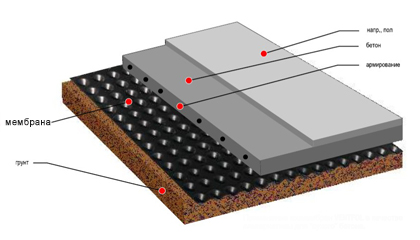
Installation of a tongue-and-groove membrane horizontally (concrete footings, blind areas, concrete roads, exposed roofing, etc.):
- The tenon membrane is laid on a previously prepared surface (used roof) or well-compacted soil and sand (concrete footing, blind area, road).
- Place the membrane on the prepared base:
- For blind areas: the membrane sheet is placed with spikes upward along the entire width of the surface and placed 20-30 cm onto the vertical part of the base. They use a spike-shaped membrane with already soldered geotextile or a separate spike-shaped membrane and thermally bonded geotextile on top. You can use a membrane with a density of 400 g/m2 or 500 g/m2.
- For a concrete base or rough concrete screed: the canvas is turned with its spikes towards the ground over the entire surface area. A spike-shaped membrane is used depending on the loading: 400 g/m2, 500 g/m2 or 600 g/m2.
- For concrete roads, paths and exposed roofs: the membrane is deployed over the entire surface with the spikes facing up and the geotextile facing up. They use a spike-shaped membrane with already soldered geotextile or a separately spike-shaped membrane and thermally bonded geotextile on top. You can use a membrane with a density of 500 g/m2 or 600 g/m2.
- The membrane is connected to each other with an overlap of 10-20 cm wide.
- The overlap seams are taped with double-sided adhesive butyl rubber tape .
- Next, we install the following layers according to the project, depending on the type of structure (concrete, crushed stone, paving slabs, etc.).
Additional products
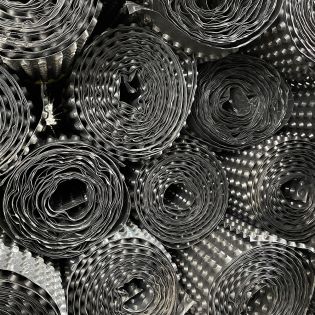




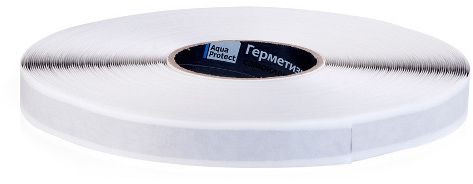 Sealant tape K2 for gluing a spiked membrane, 15 mm wide, 1.5 mm thick, 45 r.m.