

Bituminous roof waterproofing
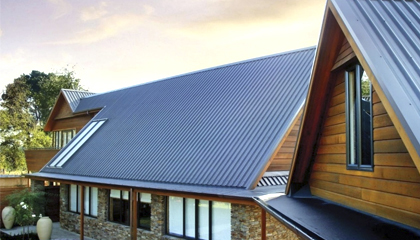
Increasingly, the roof of a building is used as a functional area, such as a terrace. Conventionally , a roof or a roof can be divided into two types:
- unused – this includes single-pitched, gable, hip, hipped, domed, mansard roofs.
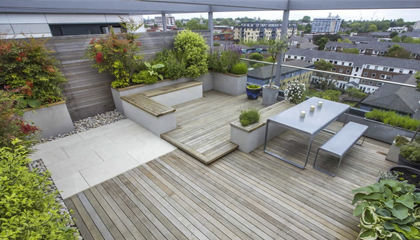 the exploited one is always a flat roof, which can serve as a terrace, a sports ground, a winter garden, actually returning the area occupied on the land plot by the house to its roof.
It is impossible to create a high-quality roofing without discussing such an important point as waterproofing the roof. To avoid undesirable consequences, first of all, during the repair or even during the construction of the facility, it is necessary to carefully prepare for waterproofing work. It is necessary to take into account all the features of the roof, since each of its types requires an individual approach.
Waterproofing protects the roof from moisture, while providing good vapor permeability. This means that all the water vapors that form in the room go outside, and do not form condensation, which leads to wetting of the roof insulation, and, as a result, to its damage. Buildings where proper and high-quality roof waterproofing is performed have durability and reliability.
Waterproofing of the roof today can be carried out in a variety of ways: from mastics and parchment, to polymer membranes. But the most popular was and remains bitumen waterproofing of the roof.
Bitumen mixtures that consist of asphalt-resinous substances and high-molecular hydrocarbons. Asphalt-resinous substances are nitrogen, sulfur and oxygen. There are natural and artificial bitumen. Natural bitumen is made from a natural derivative of oil, and artificial bitumen is made as a result of processing residues from the distillation of oil and various resins.
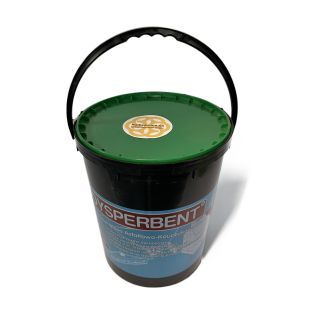
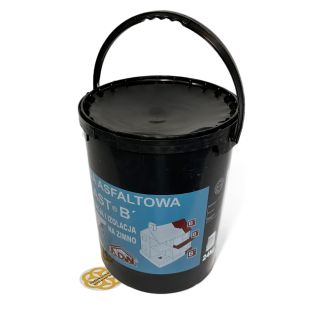
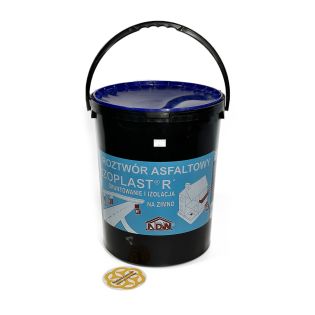
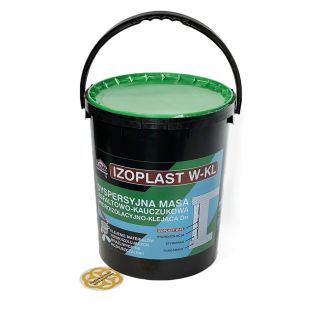
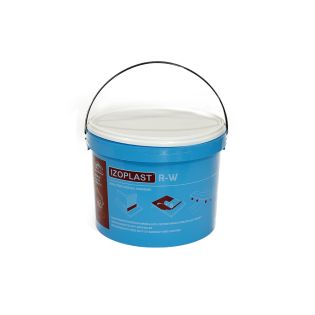
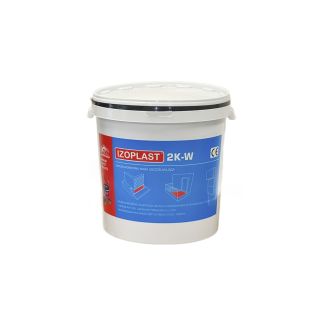
Roofing material is a very common bitumen waterproofing material, which is made from special roofing cardboard impregnated with bitumen. Roofing material is recommended to be used for the purpose of roofing. But very often, after its improper installation and sealing of joints, leaks form and the roof collapses. To solve this problem, for effective waterproofing of the roof, our experts suggest using the following waterproofing materials TM IZOPLAST: Izoplast B - bitumen-rubber mastic based on solvent, Izoplast 2K-W - bitumen-rubber mastic based on solvent for gluing new sheets of roofing material or Izoplast Dysperbent - bitumen-rubber mastic based on water. Before applying any of these products, the roof surface must be prepared with a primer Izoplast R or Izoplast R-W.
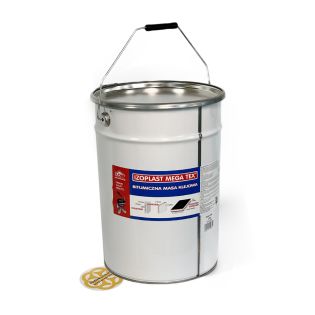
Cracks, cracks and ruptures of the roof covering often form on the roof surface. In order to prevent such deformations of the roof in the future, defects must be eliminated immediately. It is for this purpose, in the process of waterproofing the roof, we recommend using the mass Izoplast Mega-Tex, with which you can fill not only all the small cracks and eliminate small leaks, but also close up the gaps around the chimney.
As a result of air falling under the sheets of roofing material, the coating can swell and form some bubbles. Thus, it quickly deteriorates, and it has to be replaced with new material. To glue the swollen parts of the roofing material, we recommend using bitumen mastics Izoplast B and mass Izoplast Mega-Tex. Izoplast B is an ideal mastic for the process of gluing roofing material to different types of surfaces. Before applying these adhesives, the surface must be treated with a primer Izoplast R.
Using modern and high-quality materials, you will protect yourself from possible problems and the complexity of their solution. To get professional advice, you can always contact our specialists.